
Learning some basic words and phrases of the country you are visiting, even for a short stay, is important for several reasons:
 1. Enhances Communication
Even though many locals may speak English, knowing basic words like hello, thank you, excuse me, and where is…? can help you navigate situations more easily. It ensures that you can ask for directions, order food, or seek assistance without struggling.
2. Shows Respect for the Local Culture
Making an effort to speak the local language, even just a few words, shows appreciation and respect for the country’s culture. Locals often respond more warmly to tourists who try to engage with their language, making interactions friendlier.
3. Improves Travel Experience
Knowing key phrases helps you feel more confident and independent while exploring. You won’t always have to rely on translations or mobile apps to understand signs, menus, or transportation systems.
4. Helps in Emergency Situations
In case of an emergency, knowing phrases like help, police, doctor, or I am lost can be crucial. It allows you to seek assistance quickly without relying on someone understanding English.
5. Connects You with Locals
Speaking a few words in the local language can lead to meaningful interactions and friendships. Locals may appreciate your effort and be more open to sharing insights about their culture, traditions, and hidden gems of the city. And they appreciate the effort.
Pronunciation
German pronunciation is quite consistent, but there are some differences from English. Here’s a basic guide to help you pronounce German letters correctly.
Consonants
- B → Like English B (Ball – “Bal”)
- C → Usually like K before A, O, U (Cafe – “Ka-fay”)
Like Ts before E, I (Cent – “Ts-ent”) - D → Like English D (Dank – “Dank”)
- F → Like English F (Fisch – “Fish”)
- G → Hard G like in go (Garten – “Gar-ten”)
- H → Like English H (Haus – “Hows”)
- J → Like English Y (Ja – “Ya”)
- K → Like English K (Kalt – “Kalt”)
- L → Clear L, like in love (Licht – “Licht”)
- M → Like English M (Mann – “Mann”)
- N → Like English N (Nacht – “Nakt”)
- P → Like English P (Pferd – “Pf-aird”)
- Q → Always with U, sounds like Kv (Quelle – “Kveh-le”)
- R → Throaty, rolled in the back (Rot – “Rrroht”)
- S → Sounds like Z at the beginning of words (Sonne – “Zon-nuh”)
Like S at the end (Haus – “Hows”) - T → Like English T (Tisch – “Tish”)
- V → Often sounds like F (Vater – “Fah-ter”)
- W → Like English V (Wasser – “Vah-ser”)
- X → Like Ks (Xylophon – “Ksy-lo-phone”)
- Y → Like German Ü (Typ – “Tüüp”)
- Z → Like Ts (Zeit – “Tsait”)

Umlaute (Ä, Ö, Ü)
- Ä → Like “ae” in case (Käse – “Kaese” english: cheese)
- Ö → Like “oe” in girl (rounded lips) (Schön – “Shurn”)
- Ü → Like “ue” with rounded lips (Müde – “Mue-de”)
Special Combinations
- Sch → Like Sh in ship (Schule – “Shoo-le” – english : school)
- Sp / St → In most words, sounds like Shp and Sht (*Sport – “Shport” – english : sport, Straße – “Shtrah-suh” – english : street)
- Ch → Soft after E, I, Ä, Ö, Ü (like the H in “huge”) (Ich – “EeHh”)
Hard after A, O, U (like the ch in Scottish “loch”) (Buch – “BooHh” – english : book) - ß (Eszett / sharp S) → Like a double S (Fuß – “Foos” – english : foot)
Here are some Basic German words to use while in Vienna:
Greetings & Essentials
- Hallo – Hello
- Guten Tag – Good day
- Guten Morgen – Good morning
- Guten Abend – Good evening
- Tschüss – Bye
- Auf Wiedersehen – Goodbye / See you again
- Bitte – Please / You’re welcome
- Danke – Thank you
- Entschuldigung – Excuse me / Sorry
- Ja – Yes
- Nein – No
Getting Around
- Wo ist …? – Where is …?
- Wie komme ich nach …? – How do I get to …?
- Links / Rechts / Geradeaus – Left / Right / Straight ahead
- Ein Ticket nach … bitte. – A ticket to … please.
- Wie viel kostet das? – How much does that/this cost?
- Haben Sie eine Karte? – Do you have a map?
At a Restaurant/Café
-
-
- Ich hätte gerne … – I would like …
- Die Speisekarte, bitte. – The menu, please.
- Was empfehlen Sie? – What do you recommend?
- Ein Bier / Einen Kaffee, bitte. – A beer / A coffee, please.
- Zahlen, bitte. – To pay, please.
- Die Rechnung, bitte. – The check / bill , please.
-
Emergency & Help
-
-
- Hilfe! – Help!
- Ich brauche einen Arzt. – I need a doctor.
- Rufen Sie die Polizei! – Call the police!
- Ich habe mich verlaufen. – I am lost.
- Sprechen Sie Englisch? – Do you speak English?
-
Polite Expressions & Basics
-
-
- Gerne! – With pleasure!
- Kein Problem! – No problem!
- Alles klar! – All clear! / Got it!
- Wie geht es Ihnen? – How are you? (formal)
- Mir geht es gut. – I’m doing well.
- Und Ihnen? – And you?
- Ich verstehe nicht. – I don’t understand.
- Können Sie das wiederholen? – Can you repeat that?
- Langsamer, bitte. – Slower, please.
- Was bedeutet das? – What does that mean?
-
Transportation & Directions
-
-
- Wo ist die nächste U-Bahn-Station? – Where is the nearest subway station?
- Wie lange dauert es bis …? – How long does it take to …?
- Kann ich das zu Fuß erreichen? – Can I reach this by foot?
- Ich brauche ein Taxi. – I need a taxi.
- Ich möchte ein Fahrrad mieten. – I’d like to rent a bike.
-
Shopping & Money
-
-
- Ich schaue nur, danke. – I’m just looking, thanks.
- Haben Sie das in einer anderen Größe? – Do you have this in another size?
- Ich nehme das. – I’ll take it.
- Können Sie mir einen Rabatt geben? – Can you give me a discount?
- Nehmen Sie Kreditkarten? – Do you accept credit cards?
- Wo ist der nächste Geldautomat? – Where is the nearest ATM?
-
Eating & Drinking
-
-
- Ein Tisch für zwei, bitte. – A table for two, please.
- Ich bin Vegetarier. – I am vegetarian.
- Ich habe eine Allergie gegen … – I am allergic to …
- Was gibt es als Tagesgericht? – What is the dish of the day?
- Kann ich Leitungswasser haben? – Can I have tap water?
-
Accommodation & Check-in
-
-
- Ich habe eine Reservierung. – I have a reservation.
- Haben Sie ein freies Zimmer? – Do you have a free room?
- Gibt es WLAN hier? – Is there WiFi here?
- Könnten Sie mir ein Taxi rufen? – Could you call me a taxi?
-
Austrian Dialect & Local Expressions
Since Viennese German has a unique charm, locals might also say “Servus” (hello/goodbye) or “Grüß Gott” (a formal greeting).
-
-
- Servus! – Hello/Goodbye (informal, very Viennese)
- Grüß Gott! – Formal greeting used in Austria
- Baba! – Bye (casual)
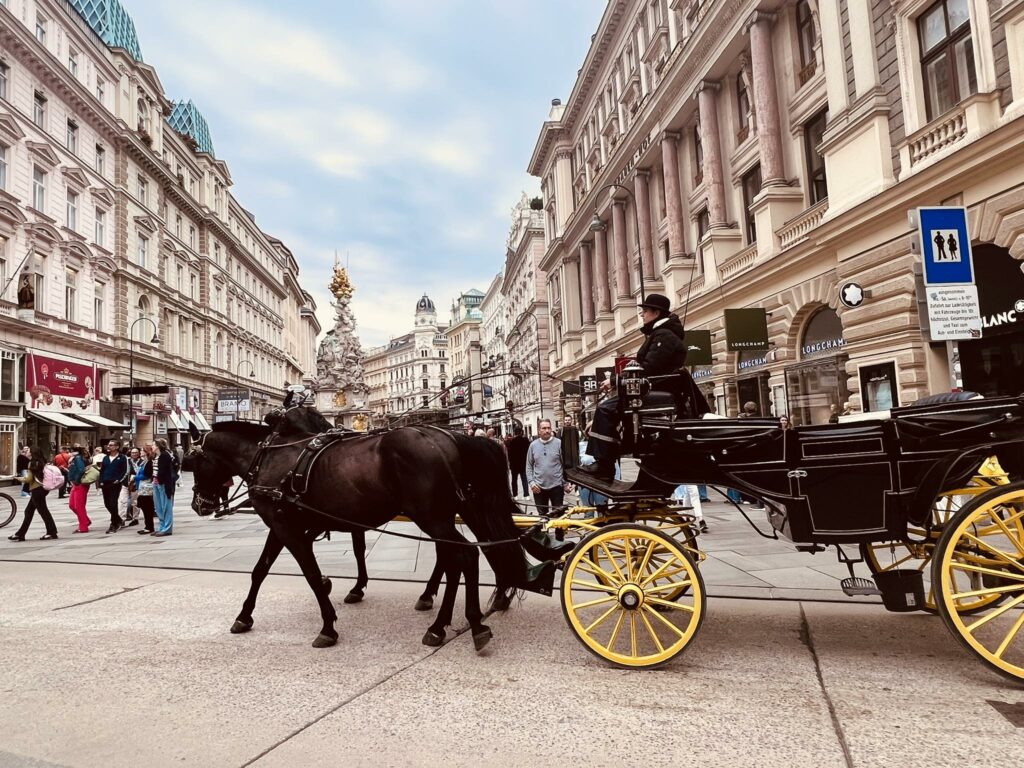
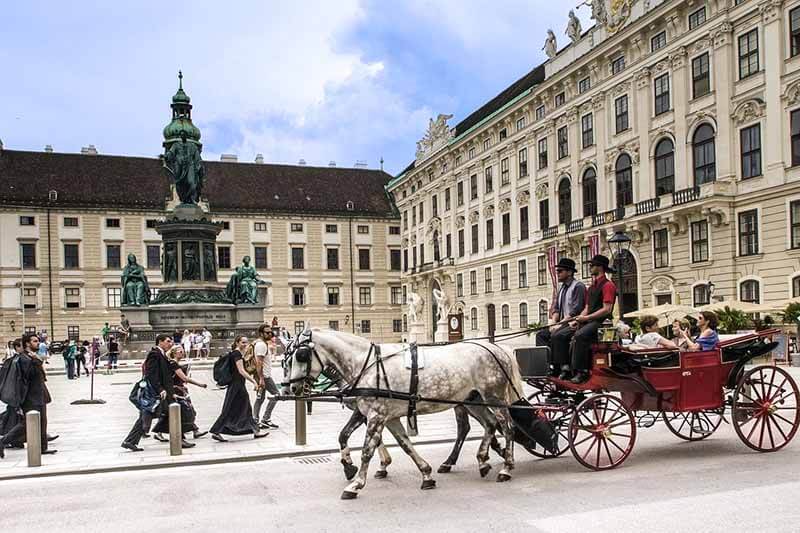
- Fiaker – A horse-drawn carriage, popular in Vienna
- Heuriger – A traditional wine tavern
-
--------------------------Book your Vienna stay here!--------------------------


Leave a Reply